



New exemptions for commercial agents – the good, the bad and the devil in the detail
August 8, 2016
Large property owners who manage, lease and sell their own assets are one of the biggest winners under an amendment to NSW’s Property, Stock and Business Agents Act.
The Property, Stock and Business Agents Amendment (Property Reports and Exemption) Regulation (NSW) 2016 came into effect on 15 August 2016. These new exemptions are likely to have both a positive and negative effect for both commercial real estate agents and substantial property owners.
In very broad summary (but the devil is in the detail! – see below), there is now a complete exemption from the requirements of the Property, Stock and Business Agents Act 2002 (NSW) (PSBA Act) for commercial agents either:
- acting for a substantial property owner (ie owning property exceeding particular thresholds); or
- engaged by an owner within its own corporate group (provided that the entities are linked in a particular way).
It’s important to be aware that the exemptions won’t apply to all commercial agency relationships.
The Good
The new exemptions are great news for large property owners who manage, lease and sell their own assets via a separate, but related, licensed entity (which usually charges a fee to the owner). It means that those internally controlled agency entities no longer have the administrative burden of maintaining a real estate agent’s licence (including paying fees, annual CPD, required signage etc), managing trust accounts and holding PI insurance. It’s easy to understand why certain large shopping centre owners have been pushing for this change for many years.
It’s also great news for large commercial real estate agencies who will no longer need to ensure that they strictly comply with NSW agency law, particularly in the area of having compliant agency agreements, for their large clients. The courts have been brutal with real estate agents who do not have strictly compliant agency agreements (ie signed at the right time, containing all of the prescribed terms in the right places, and signed and served properly). In a commercial property industry which is largely dependent on relationships, it makes sense to relax the strict requirements so that agents can collect the agreed commission without having to jump through hoops.
The Bad
The changes also lead to a negative result for commercial real estate agents. If large property owners can now easily internally manage their property management, leasing, acquisitions and disposals, there is now less disincentive to outsource this previously troublesome role to an external licensed real estate agent.
Our understanding is that the legislation was passed with little opposition from the real estate industry. Most large real estate agencies couldn’t oppose the changes without offending their most important clients!
However, as in any industry, there’s always a place for absolute experts. Ultimately, it’s likely that large property owners will always want to deal with the experts employed by large commercial real estate agencies, even if it is now easier to choose to do some of the work themselves.
Devil in the detail
The exemptions only apply to “commercial property agency work” – that is selling, purchasing, exchanging, leasing, managing or otherwise dealing with property that isn’t “residential property” or “rural land”. Both “residential property” and “rural land” have particular meanings in the PSBA Act and it is possible that a property you thought was exempted as commercial may well be captured by the strict definitions.
The new exemption for internally managed commercial agents only applies if the agent entity is an “affiliate” of a principal/owner. This can be any agent entity that is controlled by an owner entity (ie if it has the power to make decisions about its financial and operating decisions). For entities which are body corporates, subsidiaries and parent companies are also affiliates. Affiliates can be, but aren’t limited to, companies, trusts (including trustees), partnerships and individuals. This means that most corporate groups will be captured by the definition, but it’s worth being aware that particular shareholding, unit ownership and external custodian/trustee relationships for some fund managers, trusts and investment schemes may not strictly comply.
The new exemption for substantial owners only applies to real estate agents acting on behalf of a principal/owner who owns property worth at least $40 million (at market value) or with an aggregate gross floor area of at least 20,000 square metres. The value and floor space amounts will include property that is co-owned an affiliate, presumably only to the extent of the ownership, but this is not clear. However, it is important to note that property that is wholly owned by an affiliate and not by the principal/owner itself, is not counted within this threshold.
NSW vs national position
The amendments bring NSW agency law closer to its Queensland counterpart, with 2 important differences:
- the Queensland thresholds are less ($10 million and 10,000 square metres); and
- the NSW exemptions are based on the principal/owner, whereas in Queensland they are based on the property or the parties that for the relevant transaction/agency agreement.
It’s noteworthy that NSW originally followed the Queensland approach in an earlier version of the new regulation, but changed it to its current state after a period of public consultation.
None of the other states/territories in Australia currently offer complete exemptions from the relevant agency legislation for commercial agency work.
News
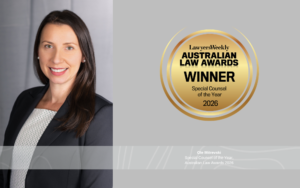
Special Counsel of the Year Award 2026
Congratulations to Ole Mitrevski, who has been recognised as Special Counsel of the Year at the Australian Law Awards 2026. We are incredibly proud of you Ole on this well-deserved achievement.
August 5, 2026
New Special Counsel Promotion
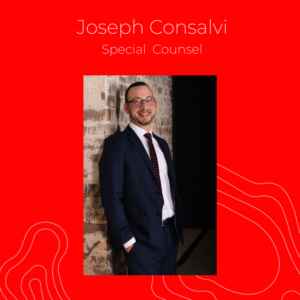
It is with great pleasure that we announce Joseph’s promotion to Special Counsel. Joseph is known and respected across the legal and property industries, particularly for his work in government and airport transactions, major developments and renewable energy projects.
Joseph is an exceptional leader and a skilled technical lawyer. We are proud to have him on our team.
Congratulations Joseph Consalvi, from all of us at Massons, on this significant career milestone.
July 29, 2026
10 years of Massons

July 1, 2026
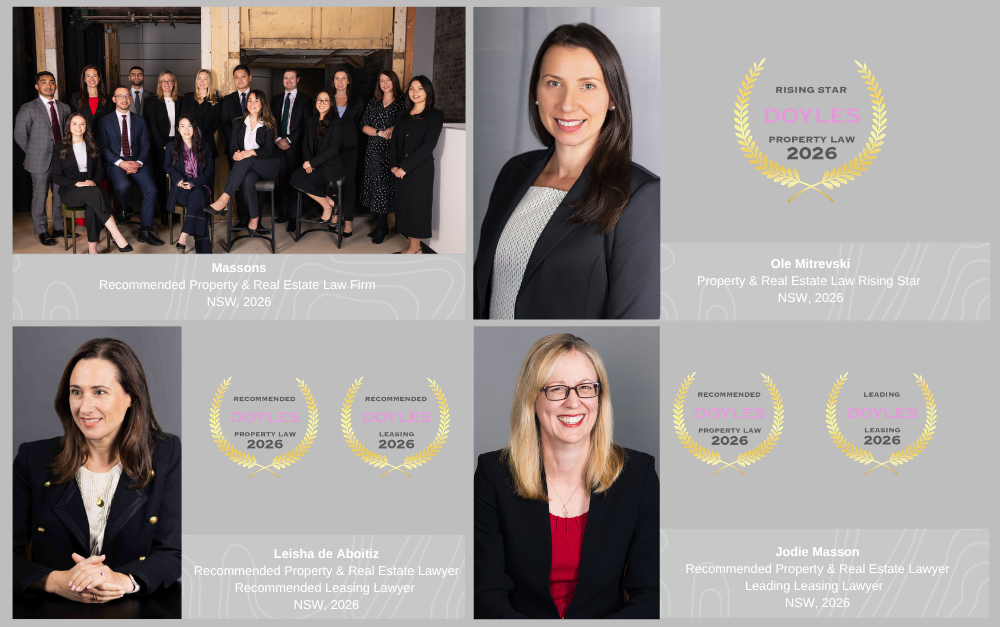
Doyle Guide 2026
Congratulations to our Jodie Masson, Leisha de Aboitiz and Ole Mitrevski, all recognised for their individual contributions this year in Doyles, as well as Massons. This is special for us as rankings in Doyles are determined by votes collected by our peers in the legal profession. We are grateful to be part of this industry.
April 9, 2026
Legal 500 - Asia Pacific 2026 - Real Estate
Thank you to our clients, our team and Legal 500 for this recognition!

February 5, 2026
Australian Law Awards - Property Team of the Year 2025
Thank you to our clients and colleagues for their strong support and of course to our amazing team. To be named property team of the year at the Australian Law Awards for the second year in a row is a shared success and we couldn’t be prouder. It’s a privilege to do what we love, with a team we love, and for clients that we love, every day!

August 18, 2025

Australia's commercial property law experts